
From Comparison to Calling: Redefining the Leader’s Scorecard
Ernest Hemingway said, “There is nothing noble in being superior to your fellow man; true nobility is being superior to your former self.” I love this quote, and I’ve been seeing that any attempt to be better than other people is a path to fatigue, exhaustion, and a deep lack of fulfillment.
I was having a conversation with a young leader this week. He was frustrated and contemplating a career change. As we dug into the emotion, it became clear that he was comparing his success to another leader in a different organization and was unhappy with his level of recognition. When I pressed into his identity and purpose, it became clear that his current role was actually closely aligned with what mattered most to him, but comparison and lack of recognition were robbing him of the ability to see the potential for deeply meaningful work right where he was.
I told him that until he did the hard work of building his own scoreboard, he would be trapped playing someone else’s game—and in that game, he can’t win.
Dan Sullivan and Dr. Benjamin Hardy, in The Gap and the Gain, teach a brilliant methodology that helps people see their own progress and growth. They talk about “measuring backwards” and recording three wins from each day, along with three wins you’re planning to have tomorrow. This simple practice shifts focus from what you lack to how far you’ve actually come.
I’m learning that true freedom only exists within the construct of structure. Apart from structure, life is reactive. Most of us are seeking the joy and freedom that come from proactively structuring what we really want and what we really want to do.
I want to find out why there is a lack of leadership in the local church. I originally—and probably a bit too early—started down a path focused on identity, purpose, and calling. I still think this is at least a piece of the puzzle, but I’ve grown in my thinking. Identity, purpose, and calling are crucial, yet focusing only on them can become a limiting factor if we ignore structure, development, and systems. I was dreaming of a simple process of identity formation, purpose focusing, and then seeing a major movement of church growth and expansion growing out of that work.
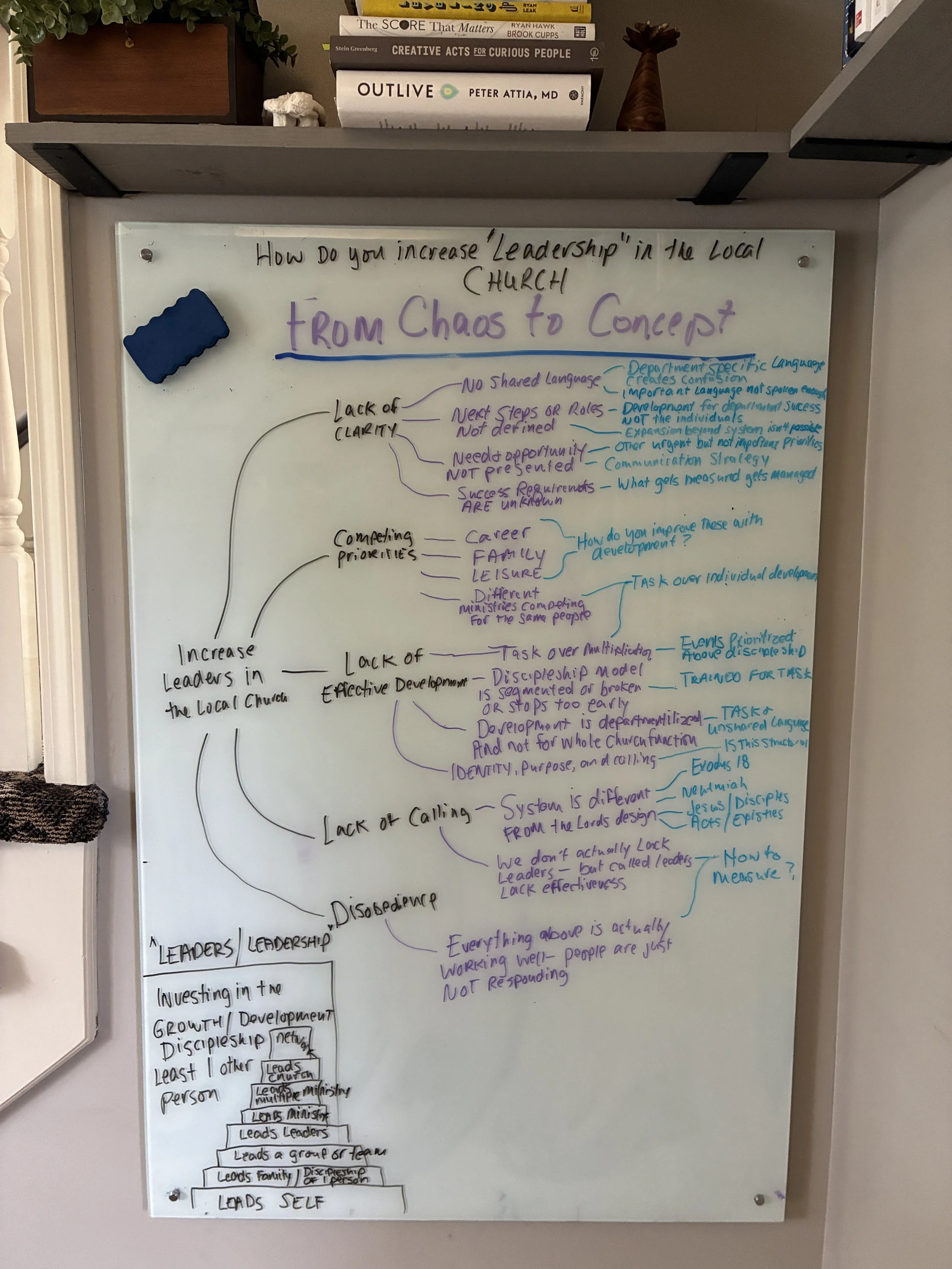
Logic Trees are Powerful Thinking Tools. Identity, Purpose, and Calling now seem like a smaller piece than I originally thought.
As I’ve leaned into my own growth and development, I’m beginning to recognize that the thinking, reading, learning, research, and writing are my real scorecard. Would I love to be part of God’s next major revival, something like the Jesus Movement of 1972? Absolutely. But if I let that desire drive my thinking, I run the risk of playing someone else’s game. If I define my game as faithful research, learning, and writing, I’ve already won by doing the work. I’m going to do the work—the research, the learning, the writing—and trust the Lord for the results.
I don’t lose if external factors beyond my control keep me from world‑changing outcomes. I lose if I don’t lean into the daily work. Hemingway’s quote is powerful, and I’m thankful for how I’m growing into a better version of myself, driven by identity, purpose, and calling—not by external factors beyond my control.
Leaders, what’s your scorecard? What game are you really playing? What would it look like to build your own scoreboard?