
What 25 Kansas City Teenagers Taught Me About Leadership
I walked into the room to teach leadership to a group of 25 students from the Kansas City Chinese Association. I hadn't had much conversation about the goals or desires of the organization, and in my last conversation with them I'd explained that I could use a format similar to the one-day seminars I'd done in Pakistan.
But I walked in with a much different approach. I knew how I was going to start and what I wanted to learn in the first hour, but I didn't have much else planned — other than to try to use everything I've been learning and doing over the last several months to serve them as best I could.
Henry Ford has been credited with saying, "If I listened to the people, I'd have just made a faster horse." I didn't know what a group this driven (at a leadership camp during summer break) and this intelligent (a few are trying to get into MIT) would want from the day. But I figured that listening to them would be better than doing what I thought they needed, given the fact that I didn't know any of them.
Defining Leadership Together
We started the day the way I start most trainings: by defining leadership as a group. This is where I began to see their brilliance. It started as a group competition, and the submissions were amazing.
My two favorite definitions of leadership come from executive coach Randall Stutman — "Leadership is making people and situations better" — and a paraphrase of a Dwight Eisenhower quote: "Leadership is the art of getting people to want to do what must be done."
Despite the fact that none of the students had read John Maxwell, they landed — on their own, through a series of reflective questions and group think — on "Leadership is influencing people."
Once we were all on the same page about leadership, I wanted to help them see how valuable these skills and competencies are, no matter what they feel their identity, purpose, or calling to be.
The Question That Changed the Room
Our next exercise had them close their eyes and imagine many years from now, being cared for by hospice workers, and answering this question: At the end of your life, what are the three to five things you're most proud of?
I shared what I want to celebrate:
The most epic 50th anniversary party ever. My wife and I both come from divorced families, and one of my core values is my relationship with her.
Taking my grandkids on an epic mountain adventure. This will require a focus on both physical and relational health with my family to pull off. It hits a core value around scope — the pull toward adventure.
Publishing more books and academic journal articles. I want to make a big impact, and learning, reading, research, writing, and training are my favorite ways to do that.
Preaching in churches in at least 10 different countries. This connects to my core value of faith, as well as radius and scope — impact and adventure.
As I shared mine, I could see them begin to process it, and they really leaned into the exercise. What surprised me most: 17 of the 25 students named career success and economic advantage as the primary thing they wanted to celebrate at the end of their lives.
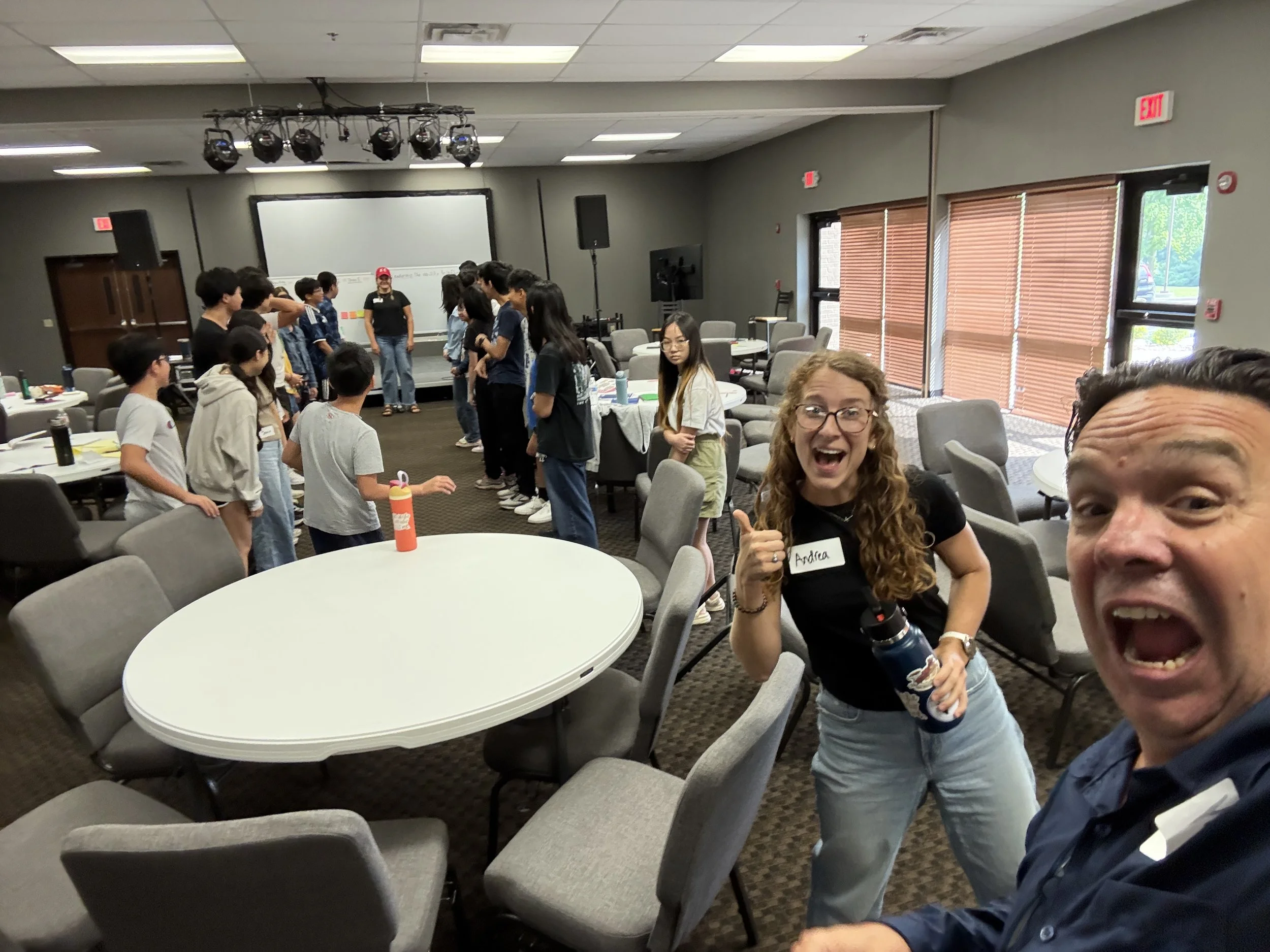
More fun than most labratories :-)
I'm not sure whether the driver was age or culture — probably some combination of both, given what I've studied around maturity and identity development — but the split was striking. It's a reminder that at 16 and 17, with college and career looming large, achievement is often the most concrete language available for describing a life well-lived. Part of what I hope this exercise did was start giving them other language — relationships, faith, adventure, contribution — to describe that same impulse.
Tying It Back to the Competencies
We spent the rest of the day digging into how the seven competencies — Know Self, Know Others, Manage Self, Manage Relationships, Develop People, Build Teams, and Solve Problems — have the potential to help with any of these goals. Everything on my list, and everything on all 25 of theirs, required other people. Which means all of it requires leadership.
I walked away inspired and encouraged about the future. I'm thankful for that room, and I can already see how that day will keep pushing me toward my own #3.
So, leaders, I'm wondering: What do you want to celebrate at the end of your life — and what are you doing today to build toward that celebration?