
Purpose Isn't a Goal — It's a Pattern
What Is Purpose, Really?
Almost everyone agrees: a clear purpose — for your life, your team, your business — changes everything. The science backs this up strongly, with research linking purpose clarity to greater life satisfaction, resilience, and even longer life expectancy. But here's the tension no one seems to resolve cleanly: researchers and writers can't agree on what purpose actually is, or how you know when you've found it. That's the question I keep sitting with.
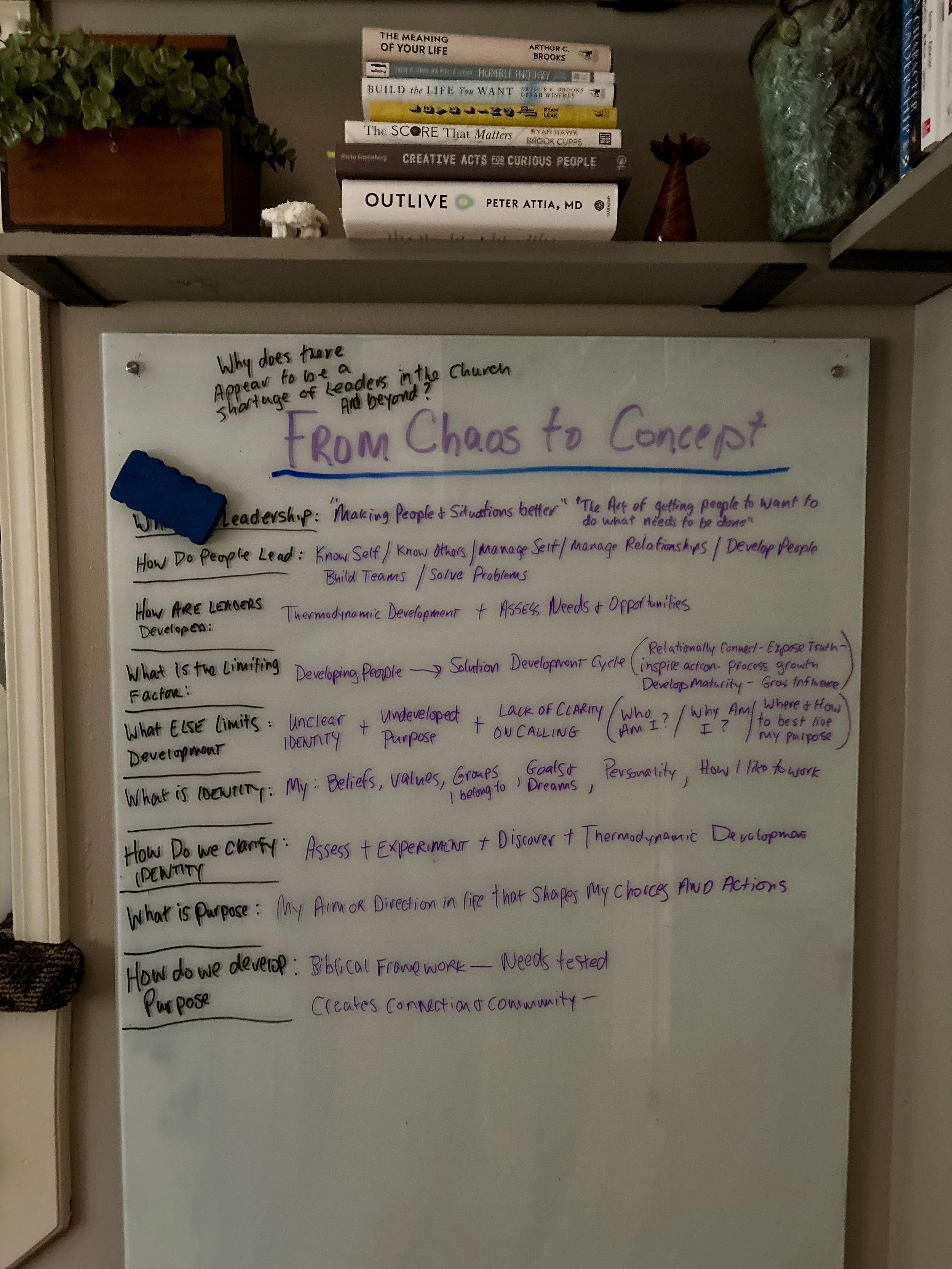
How the questions and work keep progressing
In a 2025 cross-cultural study, Mask, Folk, and Heine collected over 2,000 open-ended responses from American adults to map the landscape of human purpose, ultimately identifying 16 distinct purpose categories — including family, relationships, self-improvement, religion/spirituality, happiness, mattering, service, and perseverance. Expanding the study to 1,048 participants across the U.S., Poland, Japan, and India, they found that despite cultural differences, people worldwide draw from a remarkably similar well of purposes, with happiness, self-sufficiency, and family consistently ranking highest. Critically, not all purposes lead to the same outcomes: service and mattering were the strongest predictors of a meaningful life, while the pursuit of material wealth proved to be the weakest predictor of well-being across every culture studied.
Jordan Grumet, MD, in Purpose Code, pushes this even further — arguing that purpose lives at the smallest scale, not the largest. The moment you elevate purpose into something grand, a Jim Collins-style BHAG (Big Hairy Audacious Goal), you've left purpose behind and entered the territory of anxiety. What Grumet is describing is something closer to a practice than a destination. He also offers one of the more striking markers I've encountered: you'll know you're living in your purpose when community and connection begin to form naturally around what you're doing. That one is still working on me.
Brian and Gabrielle Bosche, in The Purpose Factor, land on a definition I'm still wrestling with: your purpose is "what you have to do to help others." There's something right about the outward orientation — but I'm not yet convinced it's the whole picture.
What none of these frameworks engage with directly is the question I keep returning to: what does scripture say about why we were made and what we were made to do? I've been working on that for several months now.
12 Purpose Patterns from Scripture
I currently see 12 distinct purpose patterns in scripture. I call them patterns because each one combines a role or vocation with the recorded actions of Jesus in the Gospels — they're not just categories, they're portraits. I started with 10, expanded to 12, and continue to refine them. My working hypothesis is that each of us resonates deeply with a few of these — they activate something in how we were wired — while others feel genuinely misaligned with who we are. These are still in early development, but here's where I've landed:
TRUTH-BRINGER — Core Longing: "I want people to know what is correct and true." Jesus Actions: Teaching, revealing, proclaiming, counseling. Biblical Work Images: Teacher, prophet, scribe, elder, rabbi, wisdom counselor.
HEALER-RESTORER — Core Longing: "I want people to be whole." Jesus Actions: Healing, restoring health, casting out demons. Biblical Work Images: Physician, healer, midwife, nurse.
PROTECTOR-DELIVERER — Core Longing: "I want people to be safe." Jesus Actions: Protecting, guarding, confronting oppression, delivering, advocating. Biblical Work Images: Soldier, shepherd, deliverer, judge, advocate.
PROVIDER — Core Longing: "I want to supply what people need." Jesus Actions: Feeding multitudes, providing fish and bread, meeting material needs. Biblical Work Images: Farmer, fisherman, hunter, baker, merchant.
HOST-WELCOMER — Core Longing: "I want people to feel welcomed and belong." Jesus Actions: Eating with outcasts, creating community, preparing the upper room, receiving children. Biblical Work Images: Innkeeper, host, butler, cupbearer, servant (hospitality).
PROCESSOR-PURIFIER — Core Longing: "I want people to see what is real and become pure." Jesus Actions: Freeing people from sin, confronting error, cleansing the temple. Biblical Work Images: Refiner, priest, fuller, temple servant.
MERCY-COMFORTER — Core Longing: "I want people to feel comfort and relief." Jesus Actions: Comforting the distressed, easing what hurts, compassion for crowds. Biblical Work Images: Comforter, mourner, compassionate servant, priest (compassion).
MESSENGER-MOBILIZER — Core Longing: "I want what is distant to become engaged and gathered." Jesus Actions: Proclaiming, challenging, gathering, sending disciples. Biblical Work Images: Herald, apostle, evangelist, courier.
BUILDER-CRAFTER — Core Longing: "I want structure and order to exist." Jesus Actions: Building, arranging, creating. Biblical Work Images: Builder, architect, potter, weaver, metalworker, mason, carpenter.
BEAUTY-MAKER / MEANING-MAKER — Core Longing: "I want hidden glory to become visible." Jesus Actions: Parables, illustrations, symbols, natural beauty references. Biblical Work Images: Artist, musician, poet, storyteller.
STEWARD-MANAGER — Core Longing: "I want resources and systems to be wisely aligned and optimized for long-term fruitfulness." Jesus Actions: Parables of talents and minas, teaching faithful stewardship, entrusting his mother to John. Biblical Work Images: Treasurer, banker, steward, household manager, administrator.
REFINER-REFORMER — Core Longing: "I want what is broken to be fixed." Jesus Actions: Judging, prophesying, restoring order, cleansing the temple. Biblical Work Images: Judge, prophet, king, reformer, elder.
I believe it's time to bring these to the leaders I work with and begin building an assessment tool — something that increases awareness first, then creates a process of discovery.
So here's my question for you: Which of these resonate most deeply? And how much of your current time, energy, and focus is actually aligned with them?
Thanks for reading — and for staying with me as I lean into my own purpose (#12, #8, #1).