
When Big Goals Don’t Change Who You Are
In 2004, my friend Matt and I were both inner‑city police officers, and we knew being fit and healthy was essential to being a “good cop”—something we both wanted to be and saw ourselves as. So when he asked me if I wanted to do a triathlon at Longview Lake, I had no real choice but to say yes. Matt was a state champion swimmer in high school, and I was very much not, so I didn’t see him again after we started until the end, about 90 minutes later.
As soon as I crossed the finish line of the half‑mile swim, 12‑mile bike, and 5K run, I told Matt, “Let’s do the Ironman!” Twenty‑two years later, I don’t remember what I thought during the swim, bike, and run that made me say that, but I very clearly remember saying it—and his immediate response of “Okay.”
I do remember training up to 24 hours a week for a six‑month period, and I really remember the first time I stood at the starting line a week before the race, looking at the bridge 1.2 miles away and thinking there was no way I could swim there, let alone there and back.
I did make the swim, and on April 9, 2005, I ran down a street in Tempe, Arizona, and heard a guy say to the crowd, “Congratulations, Jeremy Brownlee, you are an Ironman!” It was a cool experience that seemed amazing for probably less than a week. Then I realized I was still the same guy who had shown up at Longview Lake less than a year before. Doing the Ironman hadn’t turned me into a superhero or made me like working out any more than I did before it. It may have helped me develop some discipline and some goal orientation, but it definitely didn’t give me what I was looking for.
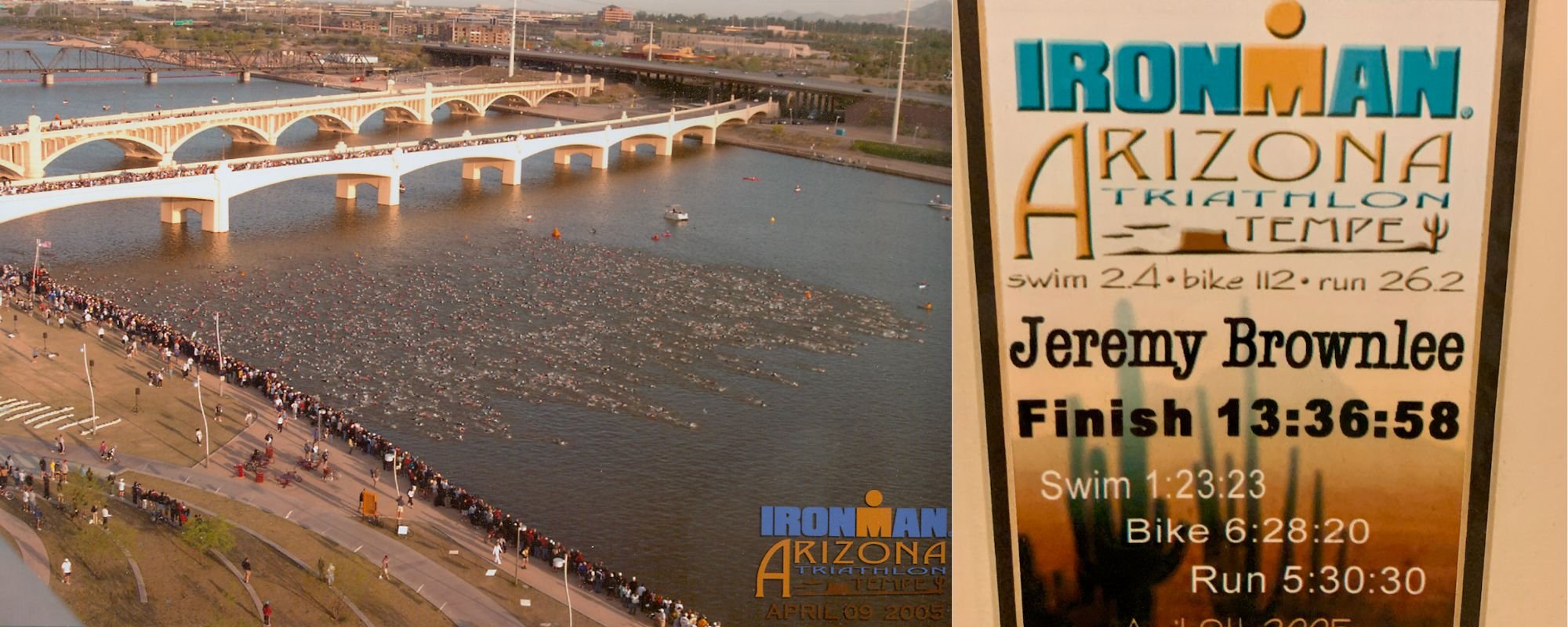
This was a dumb way to impress people, who didn’t care :-)
Arthur Brooks, in The Meaning of Your Life, has a lot to say about both goals and the people he describes as “strivers,” a group I definitely see myself in. He states, “Even very successful people often don’t know their true purpose, in fact, which is why they work so hard to achieve goals that when reached, leave them feeling empty and cold—or worse.”
Brooks is far from anti‑goal. In fact, he explains that goal pursuit can help us develop a sense of purpose, but the wrong goals can make all that achievement increase our feelings of emptiness. That was my experience with the Ironman.
To set good, purpose‑finding goals, Brooks recommends three characteristics:
They are not zero sum. A good goal leads to wins for you and for others, not you winning while someone else loses.
The motive is about pursuing something good, not fleeing from something you don’t like.
They are not positional, so you avoid social comparison. If the goal is to look better to peers or others instead of actually getting better, it’s set up to fail.
Looking at my quest for the Ironman, I can clearly see where I failed. I wanted to be an Ironman so that people would see me as fit, tough, unstoppable, and slightly crazy. It wasn’t because I truly wanted to be that; I just wanted to be seen as that so I’d feel better about myself. That’s why I experienced the “near‑depression” after a huge accomplishment.
I’ve come to realize that goals and motivations built around what others think about me don’t really do anything good—because other than my wife, most people don’t think about me that much. This isn’t sad; this is freeing, because I can set goals and grow based on who I am and what I want to do, and ultimately what aligns with my identity, my purpose, and my calling.
I read, learn, think, and write because it’s who I am and what I want to do. It helps me be fully myself, and it brings me much more joy and fulfillment than chasing things I think will impress other people.
I have much more to say about purpose, but I’m going to wait until next week—because that’s what I want to do.
Who are you, and what do you really want to do?